
Blepharoplasty
What is Blepharoplasty?
Blepharoplasty or eyelid surgery is a surgical procedure that aims to reshape the eyelids and produce a more youthful appearance. In the case of upper eyelid surgery vision can be improved as well. In the case of lower eyelid surgery eyebags are removed, skin is redistributed and the lower eyelid may have to be suspended laterally in order for its laxity to be reduced. Lower eyelid puffiness and wrinkles are also reduced. The aim of the modern blepharoplasty is to benefit the patient in terms of improvement of both function and appearance. The eyelid is a complex structure made from skin, muscle, fibrous septa, fat and ligaments. A blepharoplasty procedure may have to address all these structures. In general terms the lower eyelid blepharoplasty is a more challenging procedure compared to the upper one, due to its more complex anatomy, and the significance of its lateral area (lateral canthal tendon) in maintaining its desired position in contact with the globe and in slight upwards tilt laterally.

There are 3 fat pads in the lower eyelid responsible for the eyebags. The upper eyelid has only one fat pad medially. The lateral canthal area is a very important structure and may require additional support during lower eyelid blepharoplasty.

What are the commonest reasons for patients requesting blepharoplasty?
The short answer is ageing.
With age all tissues around the eye can slacken and that includes muscles, skin and fibrous structures. As a result of that the fat pads can prolapse and bulge forwards giving the appearance of bagginess. All excess of tissue and bagginess are often worse in the morning and that is due to positional fluid distribution when a person is lying down.
The ageing process and descent of periorbital tissues can also cause so much drooping of the upper eyelid that its skin can hang over the eyelashes and even obstruct vision.
What are the techniques involved?
The upper eyelid blepharoplasty involves skin resection and the scar is always at the upper eyelid skin crease area.
The lower eyelid blepharoplasty can be done either with an incision through the lower eyelid skin under the eyelashes (subciliary incision) or through the inside of the lower eyelid (transconjuctival)
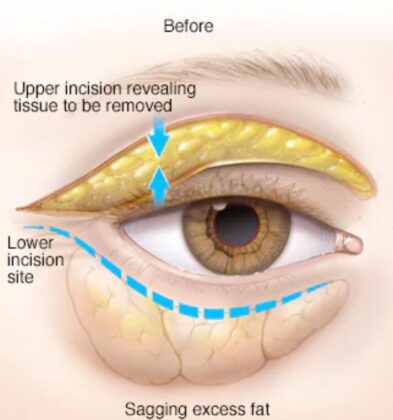
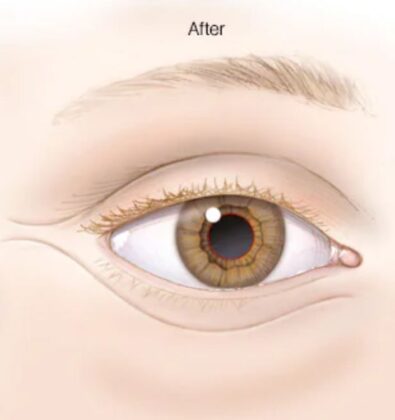
Skin incision pattern for upper and lower eyelids. The upper eyelid surgery mainly removes skin and muscle while the lower eyelid surgery (subciliary incision) removes/redistributes skin and the fat pads.
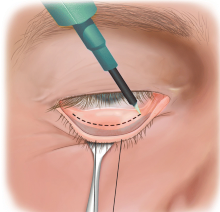
With the transconjuctival incision only fat pads can be removed from the lower eyelid as the skin can not be addressed, therefore it has limited use.
What are the risks of the procedure and what results should I expect?
In general, upper eyelid blepharoplasty is a very safe procedure and the outcome very predictable. The degree of improvement depends also on the position of the brow and the function of the brow. It may be that brow lift is also required in order to achieve the desired outcome.
Lower eyelid blepharoplasty has to take numerous factors into account including the position of the globe and cheek bones as well as the tone and degree of lower lid laxity in order to avoid a droopy eyelid after surgery (ectropion). Also, muscle dissection must be careful so the muscle maintains its innervation and therefore the proper position and tone of the lower eyelid.
Your bespoke blepharoplasty transformation overview
Consultation and Planning: 45-60 minutes
Surgical procedure: 45 min for upper eyelids, 60-75 min for lower eyelids.
Anaesthetic: Local for upper eyelids. General (you go to sleep) for lower eyelids
Hospital stay: Day case or 1 night
Follow up appointments: 1 week, 2 weeks, then 3 months and 12 months.
Time off work: 3-4 days
No Driving: 3-4 days
Exercise and Gym: 4 weeks
Consultation and Planning
Once you book your appointment with me, I will see you at your chosen time in my clinic. Your consultation will last 45-60 minutes. During this time, I will listen to your wishes, examine you, access any medical conditions you may have and focus on your specific issues of concern. Your eyelids and surrounding structures, will be assessed by me in detail and I will explain to you the significance of my findings.
Eventually a bespoke plan will be presented to you and I will make everything possible so you can reach your goals. If it is not possible to meet your expectations you will be informed about that straight away.
The consultation process is the first step, but in my opinion the most important, as it is the cornerstone of your journey.
Surgical Procedure
Your bespoke eyelid surgery procedure will take on average 45 minutes under local anaesthetic for the upper eyelids and about 60 minutes under general anaesthetic for the lower eyelids. When you wake up in recovery you will have been fitted with cool eye packs to reduce the swelling
You will stay in hospital either a few hours as a day case or for 1 night if that is your choice.
Aftercare and follow up:
Week 1 and week 2 and then at 3 months and at 12 months
Risks
In general, the risks from the procedure can be cosmetic and functional.
• Scarring. Eyelid scars tend to very good and in a few months after surgery are hardly visible
• Bruising. It lasts about a week
• Bleeding. If surgery is done carefully, you should not bleed. If bleeding occurs and is significant and no action is to be taken then the pressure on the optic nerve can increase and that can cause blindness. This is an extremely rare complication
• Chemosis. This is a swelling of the eyeball conjunctiva and usually goes away on its own in a few weeks. In some cases, steroid drops help.
• Asymmetry. In some cases, absolute symmetry may not be achieved. Almost everyone has a mild degree of asymmetry anyway.
• Overcorrection.
• Undercorrection.
• Scleral show. This happens when the lower eyelid has not been positioned appropriately or when excess tissues have been resected and the white part of the globe below the iris become visible in straight gaze.
• Ectropion. It is mainly lateral and can be due to muscle denervation, tissue overresection, failure to recognise pre-op the laxity and reduced tone of the lower eyelid or inability to execute a proper canthopexy procedure
• Unsatisfactory outcome. A very small number of patients may require another procedure to address minor imperfections.
LATERAL CANTHOPEXY VIDEO CLIP (lateral lower eyelid suspension)
Intraoperative views show the correct position and tone during lower eyelid surgery. On the left lower eyelid, I have already done a lateral canthopexy for the patient while on the right side not yet. Notice the difference in tone, position and apposition to the globe. On the left side the lower eyelid is in close contact with the globe and is slightly tilted upwards laterally and has good tone. On the right side, eyelid laxity is still present because canthopexy is yet to be done, and if unsupported then the risk of ectropion and unsatisfactory outcome would be high.
In order to avoid unsatisfactory outcomes from lower eyelid blepharoplasties I have developed specific and pioneering techniques in eyelid suspension which has culminated in great results. I have presented my techniques in various scientific meetings.
PHOTO GALLERY
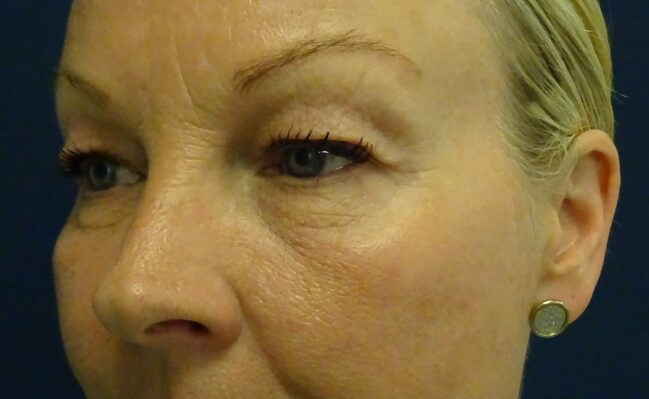
BESPOKE UPPER EYELID SURGERY
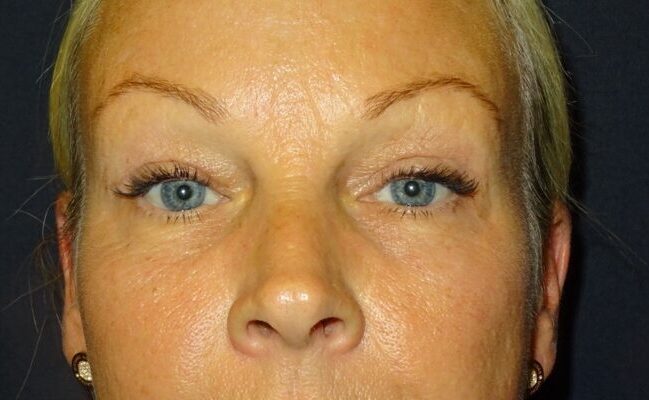
Skin and muscle removal from upper eyelids only. Notice the crisp eyelid crease after surgery.
Before and after 6 months.
-

- Before
-
- After
-
- Before
-

- After
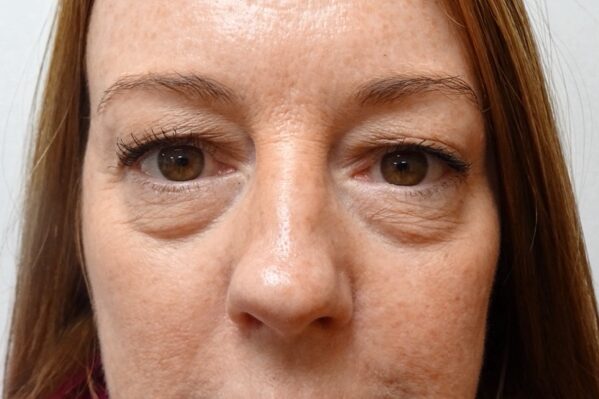
BESPOKE UPPER AND LOWER EYELID SURGERY
Skin and muscle removal from upper eyelids. For lower eyelids skin removal, fat pad removal and septoplasty. Lateral canthopexy was not required.
Before and after 6 months.
-
- Before
-

- After
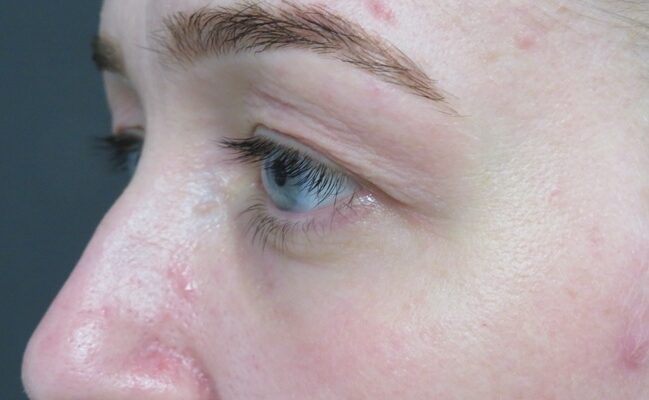
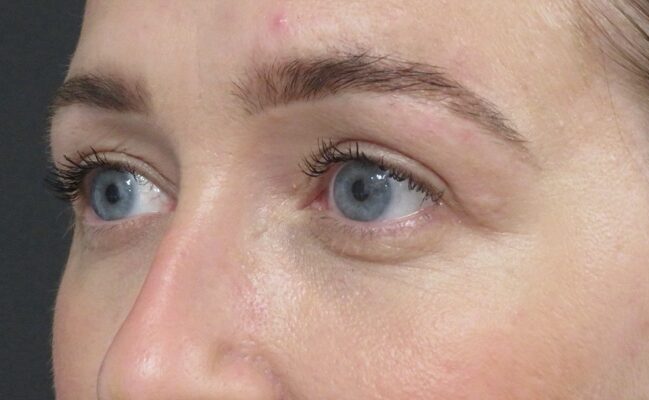
BESPOKE UPPER EYELID SURGERY
Skin and muscle resection in a young patient in order to achieve a crisp fold
-
- Before
-
- After
BESPOKE UPPER EYELID BLEPHAROPLASTY
Severe asymmetry before surgery.
Almost complete symmetry after surgery.
Before and after 12 months
-
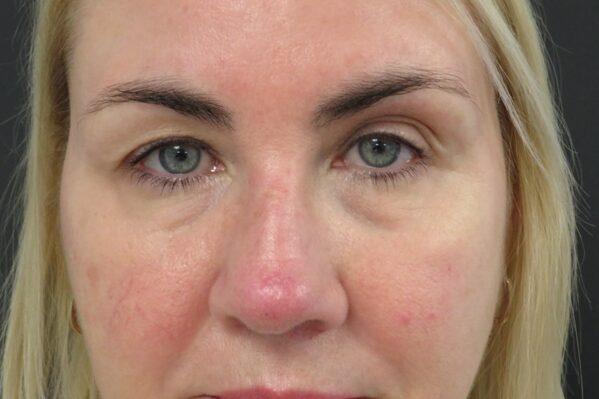
- Before
-
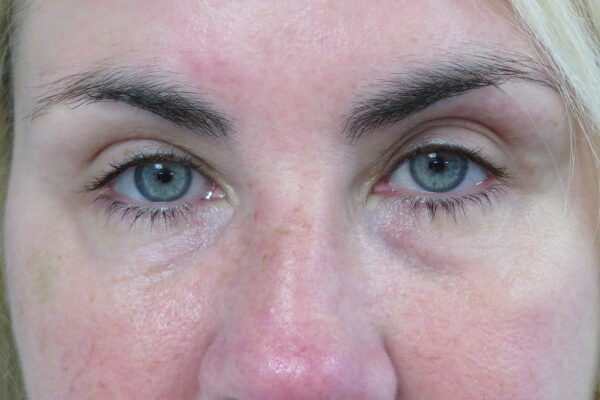
- After
 VideoandWeb.com